Online Khula for Overseas Pakistani and Foreign Nationals
If you are an overseas Pakistani wife or a foreign national married to a Pakistani husband, this complete guide to the Khula procedure for overseas Pakistanis explains how you can obtain Khula without returning to Pakistan. Fill the form for an Instant consultation via WhatsApp, Zoom, or video call.
Instant Consultation
⭐ 4.9 on Google | 50+ Client Reviews

Shahbaz Ali Khan
Complete Khula Service for Overseas Pakistanis by LEX
When you contact LEX for your Khula case from abroad, here is exactly what happens
- It starts with a detailed video or audio consultation. You tell us your issues and share relevant documents. We listen, peruse your documents, and provide full guidance on the procedure, realistic timeline, and exact fee.
- Once you decide to proceed, we assist in appointing a Special Attorney in Pakistan. If you do not have a trusted person available, we can help you arrange one.
- We draft your Special Power of Attorney specifically to your case, we do not use standard templates. We guide you for execution of SPA in Embassy or Consulate and then for cross-attestation of SPA from MOFA.
- After that, your case plaint is drafted and sent to you for review. After your approval, we file your case in relevant Court and attend hearings on your behalf.
- At the stage when court requires your personal statement, we arrange it through the E-Court system and secure your appearance via video call. No return to Pakistan required.
- We tender arguments, obtain decree, get attested copies, handle the Union Council process until the NADRA Divorce Effectiveness Certificate is issued.
- We then courier to you the complete attested case file, the attested decree of khula, and the NADRA divorce certificate.
- We operate on a fixed fee system, the fee agreed at the start is the fee you pay at the end, no hidden or extra charges.
- We also provide real-time updates via WhatsApp or your preferred channel and online case tracking.
- We never take a single step without your consent and instructions.
Your case. Your decisions. Our representation.
What Is Khula?
Khula is an exclusive legal right granted to Muslim wives under Pakistani law to dissolve their marriage through a Family Court, without the husband’s consent and without proving fault. Governed by Section 8 of the Muslim Family Laws Ordinance 1961, Khula is the wife’s unilateral right of the wife that if she is determined not to live with her husband she cannot be forced to. Unlike talaq, which belongs to the husband, Khula belongs entirely to the wife. The Family Court grants this decree, the Union Council observes a mandatory 90-day period, and the NADRA Divorce Effectiveness Certificate formally completes the dissolution. Overseas Pakistani wives and foreign nationals married to Pakistani husbands can obtain Khula through a Special Power of Attorney and E-Court video call system without returning to Pakistan at any stage.
Online Khula for Overseas Pakistani Wives or Foreign Nationals
If you’re an overseas Pakistani wife or a foreign national wife married to a Pakistani husband, and your Nikah is registered in Pakistan. In that case, you can apply for Khula online without coming to Pakistan physically.
How Online Khula Works?
Pakistan’s legal system has provisions to assist wives living abroad who seek Khula. Here’s how the process works: you, as the wife, can assign a representative in Pakistan through a Special Power of Attorney, who will then initiate the Khula proceedings on your behalf. The E-Court System also allows you to give your statement via video call.
Khula Through Special Power of Attorney
The ‘Special Power of Attorney’ is a tool for overseas Pakistani wives or foreign national wives seeking online Khula. This document empowers the wife to assign an individual, such as a family member, friend, or lawyer, to represent her in Pakistan.
This means a wife can initiate and manage the Khula case online while staying abroad, under the provisions of the Attorney Act 1882 and Contract Act 1872, without physically needing to be present and without returning to Pakistan.
The Special Power of Attorney must be attested at the nearest Pakistani High Commission or Embassy in your country of residence. After embassy attestation, the document must also be counter-attested by Pakistan’s Ministry of Foreign Affairs (MoFA) upon arrival in Pakistan. Your attorney in Pakistan handles this step before filing the case in court.
Learn more about “How to make and execute a Special Power of Attorney?”
What if You Cannot Access a Pakistani Embassy?
If you are in a country where a Pakistani Embassy is not accessible, or where your circumstances makes embassy visit impossible, be informed that there are alternate methods of executing and authenticating a Power of Attorney.
We cannot publish the details of this process publicly because it requires careful, step by step execution. Contact us and we will guide you through the appropriate procedure.
Lack of embassy access is not the end of the road.
Online Khula Using E-Court System:
Alternate to the need for the wife to appear before the court in person, the courts now facilitate the litigants and offer an electronic court system known as the E-Courts System; in this system, where the person is unable to appear physically in court, his/her statement or evidence will be recorded through video call. This system mainly facilitates overseas Pakistanis to record their statements remotely without returning to Pakistan.
This system facilitates the wife to give her statement through video calling or any other electronic means allowed or preferred by the Court. The E-Courts System is almost available in all districts of Pakistan. E-courts in Pakistan commonly use Zoom video calls, Skype video call or sometime in exceptional circumstances courts may allow WhatsApp video call as well.
What Grounds Are Required to File Khula in Pakistan?
Following are the basic conditions essentials for initiating Khula case in Pakistan:
- Free Will: The wife must express her genuine will and consent, free from coercion and undue influence, to seek Khula from her husband. Her free will is necessary, and pressure from parents or relatives must not be present.
- Determined not to live with the husband: It is a settled law that marriage should be dissolved based on Khula when the wife is not determined to live with the husband without any fault on the part of the husband. (Ref. 2014 YLR 1743).
- No need to prove aversion or hatred: A wife does not have to explain why she has developed hatred aversion for her husband or why she does not want to live with the husband. No logical reason is required to prove it. It is enough to say that she does not want to live with her husband.
It can be observed in the judgment reported as 2003 MLD 1120;
A wife cannot be compelled to live with her husband without her consent. In claiming Khula (dissolution of marriage), she doesn’t need to provide extensive reasons; her intense hatred or fixed aversion toward her husband is sufficient.
In essence, the Khula process is straightforward and clear. If a wife decides she no longer wishes to live with her husband, she cannot be compelled to stay. The dissolution of marriage does not require a stringent logical reason.
Grounds for Dissolution of Marriage Other Than Khula
The Dissolution of Muslim Marriages Act of 1939 clarifies the grounds for the dissolution of marriage and consolidates the rules of Muslim law concerning women’s right to file for dissolution of marriage under Muslim law and addresses any doubts about how a Muslim woman’s renunciation of Islam affects her marriage. under the Act, a Muslim woman can file for dissolution of marriage based on the following reasons:
- Husband’s Disappearance: If the husband’s whereabouts have been unknown for four years, the wife can seek a divorce.
- Neglecting Maintenance: If the husband has failed to provide financial support for two years, the wife can ask for a divorce.
- Additional Wife: If the husband takes another wife without following the rules of the Muslim Family Laws Ordinance, 1961, i.e., permission from existing wife(s), the wife can seek a divorce.
- Imprisonment: If the husband has been sentenced to seven or more years in prison, the wife can file for a divorce.
- Failure to Fulfill Marital Duties: If the husband has failed to meet his marital obligations for three years without a valid reason, the wife can seek a divorce.
- Impotence: If the husband was impotent at the time of marriage and continues to be so, the wife has a right to divorce.
- Mental Illness or Serious Disease: If the husband has been mentally ill for two years or suffers from leprosy or a serious contagious disease, the wife can file for divorce.
- Marriage Before Age 16: If a girl was married by her guardian before she turned 16, she can repudiate the marriage before she turns 18, provided the marriage hasn’t been consummated.
- False Accusations (Lian or Laan): If the husband falsely accuses his wife of adultery (zina), she can file for divorce.
- Cruelty: If the husband is cruel, such as:
- Regularly abusing and making her life miserable.
- Associated with bad company or leading an immoral life.
- Forcing her into immoral activities.
- Taking away her property or denying her legal rights over it.
- Preventing her from practicing her religion.
- Treating her unfairly if
11. Other Valid Grounds: Any other valid reason recognized under Muslim law can also be a ground for divorce.
Documents Required to File a Khula Case
- Copy of CNIC or Passport.
- Copy of Nikahnama
- Copy of Marriage Certificate
- Duly attested Special Power of Attorney from Embassy or Consulate of Pakistan.
What if the Wife Do Not Have Nikahnama or a Marriage Certificate?
- Even if the wife does not have the original Nikahnama or original marriage registration certificate, she can still apply for Khula using a copy only.
- In a scenario where the wife has no written proof of marriage, an affidavit on oath by the wife is required stating that the nikahnama is unavailable.
- If no written proof of marriage is in place, the statement of two witnesses of Nikah may be required to prove the existence of Nikah.
Khula During Pregnancy
A wife can apply for Khula during pregnancy by filing a case in family court. However, the divorce will not take effect immediately during the pregnancy. The Khula will only be finalised and legally effective after the delivery of the child.
What if Husband Does Not Agree to Khula?
The husband’s consent in the case of Khula is irrelevant. Whether the husband agrees or not does not affect the fate of the case for dissolution of marriage on the basis of khula. However, if the husband contests the case, the Court will grant him an opportunity to mend his marital relationship amicably and try to reconcile. However, if the wife still refuses to live with the husband, the Court will do nothing but grant Khula. In short, Khula can be granted even if the husband does not agree to Khula.
8 Steps That Covers Procedure of Khula for Overseas Pakistanis
Mainly these 8 steps are included in a case of dissolution of marriage by way of Khula:
- Appointment and Execution of Special Power of Attorney
- Institution of suit (Section 7)
- Intimation to the defendant (Section 8 )
- Written statement that may incude claim for restitution (Section 9)
- Pre-trial proceedings and immediate decree for dissolution (Section 10)
- Recording of evidence (Section11)
- Conclusion of trial with judgment and decree (Section12)
- Intimation to Arbitration Council upon decree for dissolution (Section21B)
How Long Does Online Khula Take in Pakistan?
The timeline for online Khula for overseas Pakistanis depends on the circumstances of each case. The figures below are approximate and based on general experience. Actual timelines vary depending on court schedules, bar association strikes, judicial vacations, adjournments, and whether the husband contests the case.
The first step for overseas Pakistanis is executing and getting the Special Power of Attorney attested from the nearest Pakistani Embassy or Consulate, which typically takes 1 to 3 weeks depending on your country of residence and the Embassy’s workload.
In an uncontested case, where the husband does not appear or does not oppose the Khula, court proceedings can be concluded in as little as 30 days and generally do not exceed 2 months. After the court decree, the Union Council process takes a mandatory 90 days.
In straightforward uncontested cases, the complete process from Special Power of Attorney till issuance of NADRA divorce effectiveness certificate is typically completed within 3 to 5 months.
In a contested case, where the husband actively opposes the Khula, files a counter-claim, or causes procedural delays, the timeline may extend. There is no fixed maximum for contested cases as delays are often beyond the control of either party or their lawyers.
| Stage | Approximate Time |
|---|---|
Special Power of Attorney execution and attestation |
1 to 3 weeks |
Court proceedings — uncontested |
30 days to 2 months |
Union Council 90-day mandatory period |
90 days |
NADRA divorce certificate issuance |
1 to 2 weeks |
Total — uncontested case |
Approximately 4 to 5 months |
Total — contested case |
Varies — contact LEX for assessment |
How Much Does Khula Cost in Pakistan?
Khula costs are one of the first things people ask about, and honestly there is no single answer. Every case is different. A straightforward uncontested case costs less than a contested one. The city whose court has jurisdiction also matters, as filing case in Lahore is different from Karachi or Islamabad.
Our Bar Council rules do not allow us to publish our fees. Any website showing a fixed price for Khula is either misleading you or not a registered law firm.
What you will pay for in a Khula case is your lawyer’s fee, court filing charges which are minimal government fees, Union Council processing charges, and if you are outside Pakistan, the extra cost of getting your Special Power of Attorney attested at the Embassy and couriered to Pakistan.
The honest answer is that the best way to know what your case will cost is to speak to us directly. We offer an instant consultation and will give you a straight answer and fixed fee quote after understanding your situation.
Online Khula Process in Pakistan
Here is the full step-by-step guide for 8 steps of full khula procedure for overseas Pakistanis.
Step 1: Appointment And Execution of Special Power of Attorney
The most important and initial step is the appointment of a Special Attorney — an agent and representative in Pakistan. The Special Attorney is the person who will sign your Khula case documents on your behalf and represent you in Pakistani courts while you are residing abroad.
This appointment involves two main steps:
- Execute a Special Power of Attorney and get it attested at the nearest Pakistani Embassy or Consulate in your country of residence. Then send the attested document to your attorney in Pakistan.
- Your attorney, upon receiving it, will proceed to the Ministry of Foreign Affairs (MoFA) for counter-attestation. Only after MoFA counter-attestation can the document be used in court.
Step 2: Filing a Suit for Dissolution of Marriage on the Basis of Khula (Section 7)
A plaint for dissolution of marriage will be filed in the Family Court, which has jurisdiction. The plaint may include claims related to dowry, wife’s maintenance, dower, personal property, the wife’s belongings, custody of children, guardianship, and visitation rights of parents.
LEX provides expert khula lawyers in Lahore, Karachi, and Islamabad for overseas Pakistanis seeking dissolution of marriage through Pakistani courts.
Step 3: Intimation to Defendant (Section 8) – The Khula Notice
Upon wife’s case submission, the Family Court sends the husband a summon, usually known as khula notice in Pakistan, requiring him to appear in person or through counsel and submit a written statement.
Non-appearance of Defendant/Husband:
Suppose the defendant/husband fails to appear before the court. In that case, the court shall proceed ex parte against him and directly move to record evidence, bypassing the steps of a written statement and pretrial proceedings. After recording evidence, the court will pass an ex parte decree in favour of the plaintiff/wife and dissolve the marriage.
Step 4: Written Statement by Defendant (Section 9)
After receiving the summons, if the defendant appears before the court, he must file a written statement and list of witnesses on the date fixed by the court. A husband may claim restitution of conjugal rights in his written statement, which will be treated as a plaint. Restitution of conjugal rights may empower the stance of carrying forward the matrimonial relationship of husband and wife. It may also lead the wife to forgo her maintenance till the date of the decree if the wife demands maintenance in suit for Khula.
Step 5: Pre-trial Proceedings (Section 10)
The court will fix a date for a pre-trial hearing to examine the case and attempt reconciliation between the parties.
If reconciliation Fails:
Suppose reconciliation fails in a suit for dissolution of marriage. In that case, the court shall immediately pass a decree for dissolution of marriage, and the court may direct the plaintiff/wife to surrender up to 50% of her deferred dower up to 25% of her admitted prompt dower to the husband as the case may be. The same can be observed in the judgment reported as 2024 SCMR 634 and 2023 SCMR 1394.
If reconciliation Succeeds:
Suppose the reconciliation attempt succeeds and the parties agree to a compromise or conciliation effected between them. In that case, the Court shall pass a decree or give the decision in the suit in terms of the compromise or conciliation agreed to between the parties, as the case may be.
Step 6: Recording of Evidence (Section 11)
As discussed in the summoning of witnesses, if the defendant fails to appear, then the Family Court will record the statements of the plaintiff, the defendant, and their respective witnesses (if any).
Step 7: Judgment and Decree (Section 12)
After the evidence, the court will again make another effort for compromise or reconciliation within 15 days, and if that fails, the Court will pass judgment and give a decree.
In case of an exparte decree(one-sided), the court sends a copy of the decree to the husband’s address at the wife’s cost within three days.
Step 8: Notification to Arbitration Council (Section 21B)
If and when a Family Court decrees the dissolution of a Muslim marriage, it sends an attested copy of the decree to the concerned Chairman or Secretary of the Union Council within three days. The Arbitration Council then initiates proceedings for the issuance of NADRA divorce effectiveness certificate after observing 90-days mandatory period of iddat.
Khula Certificate From Union Council
After the decree is issued and submitted to the Arbitration Council, the council will proceed with its function and send three notices/summons to the parties to give them a chance to reconcile. After the lapse of 90 days, the Union Council makes another effort for reconciliation. The Union Council then issues an effectiveness certificate from NADRA. After obtaining this, the parties can then remarry if they wish to by showing the NADRA Divorce effectiveness certificate.
Iddat After Khula
Iddat is a mandatory period to ensure that no pregnancy exists from the former husband. After khula or any other mode of dissolution of marriage, the period of Iddat is 90 days. This requires the wife to complete three menstrual cycles that typically end within 90 days to confirm the absence of pregnancy.
When Does Iddah Start After Khula?
Iddah period starts from the date of submission of the attested copy of Khula decree before the Union Council.
As soon as the decree is submitted before the Union Council, the Iddah period begins.
Is Iddah Separate from the 90-Day Union Council Period?
The 90-days waiting period in Union Council and Iddah period are not two separate waiting periods. They are the same 90 days. When the Khula decree is submitted to the Union Council, the 90-day period begins. This same period serves as both mandatory reconciliation window and the Iddah. The wife does not have to observe an additional 90-days Iddah after receiving the certificate. She is allowed to marry again right after getting certificate.
How to Update CNIC and Passport After Khula
Upon receiving your NADRA Divorce Effectiveness Certificate, your marital status does not update automatically. You must take the following steps to update your official documents.
- Step 1 — Update Your CNIC: You need to visit a NADRA office and present your Divorce Effectiveness Certificate. NADRA will update your status to single/divorcee and change your name back to your father’s name instead of your husband’s name. If you have remarried, you can directly apply for a new CNIC in your new husband’s name instead. For overseas Pakistanis, CNIC updates can be done at the nearest Pakistani Embassy or Consulate. NADRA has also introduced an app-based system, contact us or check NADRA’s official website for the latest available options for overseas Pakistanis.
- Step 2 — Update Your Passport: You will need to apply for a new passport reflecting your updated name and marital status. If you are reverting to your father’s name, your new passport will show your father’s name. If you have remarried, your new passport will reflect your new husband’s name.
Remarriage After Khula
After Khula is complete, the wife is free to remarry once the NADRA Divorce Effectiveness Certificate is issued by the Union Council after the observance of mandatory Iddah period of 90 days.
Khula allows the wife to remarry the same husband without the need for halala. For overseas Pakistanis planning to remarry in Pakistan or abroad, read our complete guide to Online Nikah in Pakistan.
Return of Dower (Haq Meher)
If the wife dissolves the marriage by way of khula, she may have to waive or relinquish up to 50% of the unpaid dower (ghair muajjal haq meher) and return up to 25% of the prompt dower (muajjal haq meher) she has already received, as per Section 10(5) of the Family Courts Act, 1964.
However, if the marriage is dissolved on the grounds mentioned in Section 2 of the Dissolution of Muslim Marriages Act, 1939, the wife is not required to return or relinquish any part of the dower. Instead, she is entitled to claim her full dower (haq meher) as per Section 5 of the same Act.
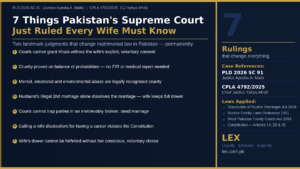
The Supreme Court has recently settled several important matters affecting women’s rights in dissolution cases. A court cannot grant khula without the wife’s free consent. Cruelty does not require an FIR or medical report to be proven. And a wife’s dower cannot be taken without her conscious, voluntary choice.
Read our full guide: Supreme Court Rulings on Khula, Cruelty and Second Marriage.
The Supreme Court has also ruled that a Pakistani wife cannot be declared disobedient simply for having a career, living abroad, or pursuing her independence. Courts that denied maintenance to wives on these grounds were acting unconstitutionally. This ruling directly protects overseas Pakistani women.
Read: Your Career Does Not Make You a Disobedient Wife — Supreme Court Ruling.
Appeal Against Khula
No appeal can be made against decree of dissolution of marriage by way of khula.
If the marriage is dissolved on the grounds of cruelty under Section 2, item vii, clause (a) of the Dissolution of Muslim Marriages Act, 1939, including abuse, immoral conduct, or denying the wife her legal rights, the decree of dissolution becomes appealable.
Other Modes of Dissolution of Marriage
- Talaaq-i-Tafweez (Delegated Divorce): In this form of divorce, the husband delegates the right to divorce to his wife in their marriage contract (Nikahnama). The wife can exercise this right if necessary. In Pakistan this power is delegated vide clause 18 of Nikahnama.
- Mubarat: This is a mutual divorce in which both husband and wife agree to part ways. It involves mutual consent, and all marital rights and obligations end upon dissolution.
- Divorce-Talaq by husband: The husband has the absolute right to initiate a divorce without needing the wife’s consent. This meant that the husband could unilaterally end the marriage.
For the complete procedure of divorce for overseas Pakistanis, read our detailed guide to Online Divorce in Pakistan.
Meaning and Definition of Khula in Islam and Pakistani Law
The following sections explain the meaning of Khula as defined in Islamic jurisprudence, classical Mahomedan law, and Pakistani statutory and case law.
Khula In Islam
The basic principle of khula comes from a verse in the Holy Quran. The interpretation is that if the wife does not want to continue in the marriage for legitimate reasons like she cannot continue her marriage within the prescribed limits of Allah Almighty, then she can return the dower (mahr) to the husband in compensation for divorce. This is called khula. The verse is reproduced here in Arabic, Urdu, and English translation.
ٱلطَّلَـٰقُ مَرَّتَانِ ۖ فَإِمْسَاكٌۢ بِمَعْرُوفٍ أَوْ تَسْرِيحٌۢ بِإِحْسَـٰنٍۢ ۗ وَلَا يَحِلُّ لَكُمْ أَن تَأْخُذُوا۟ مِمَّآ ءَاتَيْتُمُوهُنَّ شَيْـًٔا إِلَّآ أَن يَخَافَآ أَلَّا يُقِيمَا حُدُودَ ٱللَّهِ ۖ فَإِنْ خِفْتُمْ أَلَّا يُقِيمَا حُدُودَ ٱللَّهِ فَلَا جُنَاحَ عَلَيْهِمَا فِيمَا ٱفْتَدَتْ بِهِۦ ۗ تِلْكَ حُدُودُ ٱللَّهِ فَلَا تَعْتَدُوهَا ۚ وَمَن يَتَعَدَّ حُدُودَ ٱللَّهِ فَأُو۟لَـٰٓئِكَ هُمُ ٱلظَّـٰلِمُونَ
یہ طلاقیں دو مرتبہ ہیں پھر یا تو اچھائی سے روکنا یا عمدگی کے ساتھ چھوڑ دینا ہے اور تمہیں حلال نہیں کہ تم نے انہیں جو دے دیا ہے اس میں سے کچھ بھی لو ہاں یہ اور بات ہے کہ دونوں کو اللہ کی حدیں قائم نہ رکھ سکنے کا خوف ہو اس لئے اگر تمہیں ڈر ہو کہ یہ دونوں اللہ کی حدیں قائم نہ رکھ سکیں گے تو عورت رہائی پانے کے لئے کچھ دے ڈالے ، اس میں دونوں پر گناہ نہیں یہ اللہ کی حدود ہیں خبردار ان سے آگے نہ بڑھنا اور جو لوگ اللہ کی حدوں سے تجاوز کر جائیں وہ ظالم ہیں ۔٢٢٩
“Divorce may be retracted twice, then the husband must retain ˹his wife˺ with honour or separate ˹from her˺ with grace. It is not lawful for husbands to take back anything of the dowry given to their wives, unless the couple fears not being able to keep within the limits of Allah. So if you fear they will not be able to keep within the limits of Allah, there is no blame if the wife compensates the husband to obtain divorce. These are the limits set by Allah, so do not transgress them. And whoever transgresses the limits of Allah, they are the ˹true˺ wrongdoers.” [al-Baqarah 2:229]
Surah Al-Baqarah – 229
Principles of Mahomedan Law by D. F Mulla Regarding Khula
According to Mahomedan Law by D.F. Mulla, In a divorce by khula, the wife initiates it. She agrees to provide some form of compensation or consideration in return for being released from the marriage. Whether the wife waives her dower or makes another financial arrangement in favour of the husband is decided mutually between them. Once the husband agrees to the khula, the divorce becomes effective and cannot be reversed. If the wife does not pay the agreed-upon compensation, the divorce still holds validity, but the husband has the right to take legal action to recover the amount she owes. The relevant section is reproduced here;
217. (1) A divorce by khula is a divorce with the Khula consent, and at the instance, of the wife, in which she gives, or agrees to give, a consideration to the husband for the release from the marriage tie. In such a case the terms of the bargain are matter of arrangement between the husband and the wife, and the wife may, as the consideration, release her dower and other rights, or make any other agreement for the benefit of the husband.
(2) The divorce by khula is complete and irrevocable from the moment the husband repudiates the wife.
(3) The non-payment by the wife of the consideration for a khula divorce does not invalidate the divorce, but the husband may sue the wife to recover the amount payable by her under the agreement.
Khula Under Pakistani Law
Definition of Khula:
The latest definition of Khula under the reported judgment cited as 2024 PLD 645 SC:
Khula is a special right granted exclusively to women to dissolve a marriage, which men do not possess. After obtaining Khula, a woman can remarry the same man without the need for an intervening marriage (halala).
As per Moonshee Buzul-ul-Raheem v. Luteefut-oon-Nissa (1861)8 M. I. A. 379, 395. Hed., 112-116; Baillie, 303 et seg.
“Khula means to lay down.”In law, it is the laying down by a husband of his right and authority over his wife.”
“A khula divorce is virtually a divorce purchased by the wife from the husband for a price, and it is in this respect that khula differs from mubarat.”
Legal Recognition of Khula:
Pakistani legislation fully recognises and covers Khula and its related matters. Including but not limited to; the following enactments that deal with the Khula cases in Pakistan are;
- The Muslim Family Laws Ordinance, 1961
- West Pakistan Family Court Act, 1964
- Dissolution of Muslim Marriages Act, 1939
- The West Pakistan Family Courts Rules, 1965
Khula Laws In Pakistan
Section 8 of the Muslim Family Laws Ordinance, 1961, deals with the dissolution of marriage by means other than talaq, which includes Khula. A wife can dissolve her marriage by way of Khula. She can file a case under section 7 of the West Pakistan Family Court Act, 1964. A Family Court of jurisdiction has the power to adjudicate upon the matter, and the Court will assume its jurisdiction under Section 5 and Item no.1 of Schedule I of the Family Court Act, 1964.
Difference Between Khula and Mubarat
The table below will help to understand the basic difference between Khula and Mubarat (talaq-e-Mubarat).
| Khula | Mubarat |
|---|---|
Khula is initiated by Wife. |
With the mutual consent of both husband and wife. |
Wife seeks dissolution of marriage through family court. |
Do not need court’s intervention. |
No need of consent of husband |
Consent of both spouses is required. |
Wife may have to waive part of deferred dower and return
a portion of received prompt dower. |
No financial settlement required. |
Needs judicial approval and evidence. |
It requires only mutual agreement |
The court encourages amicable resolution and settlement through mediation. |
Generally more straightforward, without mandatory mediation. |
The cost of khula may include legal fees of court and engaging counsel. |
The cost of divorce by mutual agreement may only include the stamp paper fee. |
Difference Between Khula and Divorce
The table below will help to understand the basic difference between Khula and Divorce.
| Khula | Divorce |
|---|---|
Khula is initiated by Wife. |
Divorce is initiated by Husband. |
Wife seeks dissolution of marriage through family court. |
Husband pronounces divorce unilaterally without court intervention. |
Court involvement is necessary to grant Khula. After that, the Union Council issues a NADRA Divorce certificate. |
It directly goes to the Union Council to issue the NADRA divorce certificate. Court involvement is not required unless there is a dispute. |
Based on the wife’s dissatisfaction, inability or unwillingness to live within the marriage limits set by Allah. |
Based on the husband’s unilateral decision to end the marriage for any reason whatsoever. |
Needs judicial approval and evidence. |
It requires only the husband’s pronouncement. |
The husband may not have to pay the dower (mahr) if granted. |
The husband must pay the dower (mahr) and any due maintenance. |
The court encourages amicable resolution and settlement through mediation. |
Generally more straightforward, without mandatory mediation. |
If reconciliation efforts fail, it is considered as a last resort. |
It can be issued at the husband’s discretion. |
The cost of this process may include legal fees of court and engaging counsel. |
The cost of divorce in Pakistan may only include the stamp paper fee and newspaper publication fee. |
Conclusion
Khula is a legal right that every Muslim wife in Pakistan holds, regardless of where she lives in the world. An overseas Pakistani wife can start the Khula procedure without needing her husband’s consent and without returning to Pakistan. She files her case through a Special Power of Attorney, appears before the Family Court via the E-Court video call system, and obtains her decree of dissolution remotely. The decree goes to the Union Council, which issues the NADRA Divorce Effectiveness Certificate after the mandatory 90-day Iddah period. Khula is a right granted to women to free themselves from an unwanted union and Pakistani law fully protects that right.
LEX represents overseas Pakistani clients in Family Courts across Lahore, Karachi, Islamabad, and all over Pakistan, handling the complete Khula procedure remotely without the need to return to Pakistan. Whether you are based in the UK, UAE, USA, Canada, Saudi Arabia, or anywhere else abroad, our team manages every step of the process on your behalf.
At LEX we aim to provide every woman with the knowledge and understanding of their rights, fostering a sense of empowerment and autonomy in their decisions to dissolve their marriages.
Submit Your Query



If you live abroad and want any legal work in Pakistan then I would 100% recommend this company.

Mr. Shahbaz was incredibly courteous and took significant time (nearly an hour!) to fully understand my situation, asking pertinent legal questions I hadn't even considered. What truly sets him apart is his **genuine integrity.** Instead of pushing me to engage his services unnecessarily – a tactic many lawyers use to create ongoing fees – he gave me honest, practical advice.
He clearly explained the succession process with NADRA, outlining exactly what was required and how I could initiate it myself *without* needing to travel to Pakistan. His guidance was specific, clear, and incredibly reassuring during a stressful time.
Crucially, he advised that my case appeared straightforward and likely didn't require legal services at this stage. He offered his availability *only* if I encountered unexpected issues within the Pakistani system later. All of this sincere, unsolicited, and invaluable advice was provided **without any charge or demand for compensation.**
It's evident that Mr. Shahbaz specializes in assisting Overseas Pakistanis (forming most of his clientele) and deeply understands our unique challenges. He knows how to effectively navigate the government systems on our behalf.
I have saved his contact details and will keep them handy for any future need. I wholeheartedly recommend Mr. Shahbaz to any Overseas Pakistani seeking trustworthy, ethical, and expert legal guidance. His honesty and client-first approach are truly exceptional.


JazakAllah Khair! 😊

Highly recommended for all sorts of legalities.


Would rate 10 stars for the exceptional services. From the first contact till the end of court proceedings, Mr Shahbaz Khan guided us so well throughout, taking time to explain all options, and ways forward.
This was such a blessing since I didn’t have to make a trip back home for any related issues.
Everything was sorted by Mr Shahbaz and his team, in the most efficient and faultless way.
I have already recommended him to a few of my colleagues who were looking for legal advice pertaining to back home, while being in UK.
Lots of best wishes and prayers for his and his team’s further success inshaAllah. JazaakAllah khair.

Country-Wise Guide to Khula for Overseas Pakistanis
The process of getting Khula from abroad follows the same legal path regardless of which country you are in. LEX drafts the Special Power of Attorney, you take the unsigned document to the nearest Pakistani Embassy or Consulate, sign it in front of the authorised official, get it attested, and send the original back to Pakistan. Your attorney then handles the entire Family Court case on your behalf without you ever returning.
One critical warning before you proceed. A client once signed the SPA at home before going to the embassy, thinking it would save time. The document was rejected. The SPA must be signed in front of the embassy official.
If you prefer a digital route, NADRA offers an online Power of Attorney service at poa.nadra.gov.pk, which can be used as an alternative to the embassy attestation process in certain situations.
Khula from United States 🇺🇸
Washington DC, New York, Houston, Chicago, Los Angeles, these are the missions across the USA. You need to choose the one nearest to you. New York and Houston are busier than others so check all options before settling on one.
You need to bring your CNIC or NICOP as your Pakistani identity document, US passport (if you have one), two passport size pictures and your SPA signed by two witnesses. Get your SPA attested, then courier it to your attorney using any reliable international courier service ideally who provide online tracking.
Importantly, the SPA cannot be pre-signed. You have to sign it physically in front of the embassy official. Bringing an already-signed SPA may get rejected. For exact and updated requirements, always check your embassy or consulate website directly. Further procedure of Khula remains same as in the main article.
Khula from United Kingdom 🇬🇧
There are three cities, London, Birmingham, and Manchester, all have Pakistani missions. Your choice depends on where you live and which one is nearest to you. If you are in Scotland or Northern Ireland, London is your official mission though some clients travel to Manchester for faster appointments. Appointment slots are subject to availability.
You need to bring you CNIC or NICOP, British passport (only if you have it), hard copy of SPA signed by two witnesses and two passport size photos. Get your SPA attested, and after that, collect the attested document, and send it to your attorney by any trackable courier service.
One thing to be very careful, never sign your SPA before going to the embassy. It must be signed in front of the official, otherwise there is a risk of rejection. Check your embassy website for current requirements as these can change. Procedure of Khula from here onwards is covered in the main article.
Khula from Australia 🇦🇺
For Australia, the High Commission of Pakistan is in Canberra and the Consulate General is in Sydney. In practice most people use Sydney. If you are in Melbourne or Perth, it is a smart act to compare appointment slots at both offices. Canberra sometimes has quicker availability than Sydney may be because of fewer visitors.
Standard requirements apply here too. You need to bring your CNIC or NICOP, passport, printed SPA signed by two witnesses, two passport size pictures. Once attestation of SPA is done, send the attested original SPA to the attorney via courier.
Do not attend embassy appointment with a signed SPA. This is probably the most common mistake we see. The whole point of the embassy appointment is that you sign in front of the official, that is what gives the document its legal standing. Also always check the embassy website before you go as document requirements are not always the same. Khula procedure from this point is the same as explained above.
Khula from Canada 🇨🇦
In Canada, Ottawa has the High Commission and Toronto has the Consulate General of Pakistan. Toronto always gets more traffic. Pakistanis in British Columbia and Western Canada sometimes find the Ottawa slots more accessible than flying to Toronto.
Bring your passport, CNIC or NICOP, the hard copy of SPA signed by two witnesses, and two passport size photographs. Get your SPA attested and courier the original to your attorney for further process.
Please do not sign the SPA before your embassy visit. An already signed SPA will most likely be rejected at the counter. You have to sign in front of the official. For updated list of requirements visit your embassy website before going. Khula procedure after this is same as main article.
Khula from Germany 🇩🇪
Berlin has the Pakistani Embassy and Frankfurt has the Consulate General of Pakistan. Frankfurt is generally the more convenient option as it is a central location for most Pakistanis in Germany. Book your appointment at whichever mission is closer to you.
CNIC or NICOP, German residence permit, passport, two passport size photos, and the SPA signed by two witnesses are what you need to bring. Sign your SPA at the office, get your SPA attested and send the attested original to your attorney via courier.
The SPA has to be signed during the appointment, in front of the official. Not before, not at home, not on the way there. An already-signed SPA is likely to get rejected. Check your embassy website for any changes in requirements before your visit. Onwards the Khula procedure remains the same as explained in this article
Khula from Spain 🇪🇸
There is one Pakistani Embassy in Madrid and Consulate General in Barcelona, choose whichever is nearest to you. Bring your CNIC or NICOP, passport, your Spanish NIE or residence permit, two passport size photos, and the SPA printed. Sign SPA at the Embassy and send the attested original to your attorney.
Never pre-sign the SPA. We have seen cases where client has signed SPA at home or on way and the attestation was rejected at the counter. The signing has to take place in front of the attesting official, that is the whole point of the appointment. Before going, visit your embassy website and confirm what documents they currently require as requirements sometimes change. The Khula procedure after this follows the same steps explained in the article.
Khula from Italy 🇮🇹
Rome has the Pakistani Embassy and Milan has the Consulate. Most Pakistanis in Italy are in the north, so Milan tends to be the practical choice. Book your appointment as per your ease i.e., through the Milan Consulate website if you are in Lombardy, Brescia, or Bergamo, and through Rome if you are further south.
Bring your CNIC or NICOP, passport, Italian residence permit, two passport size pictures and the SPA signed by two witnesses.
People sometimes sign the SPA before visiting the embassy thinking the process will move faster. It does not work that way. The signature needs to be done in front of the official. Do check your embassy or consulate website for updated current requirements. Rest of the Khula procedure is same as described in main article.
Khula from Norway 🇳🇴
The Pakistani Embassy in Oslo covers all Pakistanis in Norway. Book your appointment through the Embassy website and bring your CNIC or NICOP, passport, two passport size pictures, Norwegian residence permit, and the hard copy of SPA signed by two witnesses. Sign before the attesting official and send the original to your attorney by courier.
Last but important point, always take your SPA unsigned to the embassy. You will need to sign it in front of the official and that is what makes the attestation legally valid. Embassy websites usually have updated requirements listed so do check before your appointment. From here, the Khula procedure is the same as what is already covered in the main article.
Khula from Saudi Arabia 🇸🇦
In KSA, there are Pakistani missions in the whole country. The Embassy sits in Riyadh, and there is a Consulate in Jeddah. It is always good to book immediately after receiving draft SPA rather than leaving it for later.
You will need your CNIC, two passport size pictures, passport, Iqama, and the hard copy of SPA signed by two witnesses. There is no need for witnesses to appear in person, instead their names, father’s names, and CNIC numbers on the document are sufficient. You need to sign your SPA in front of the official, get it attested, and courier the original attested SPA to your attorney.
Please take note, never bring your signed SPA for attestation as it may get rejected because it has to be signed before the official. Always visit your country’s embassy website for updated requirements before your appointment. Procedure of Khula onwards will remain the same as explained in the main article.
Khula from United Arab Emirates 🇦🇪
In UAE, Abu Dhabi has the Embassy and Dubai has the Consulate General of Pakistan. If you are residing in Sharjah, Ajman, or anywhere in the Northern Emirates side, Dubai will be your practical choice. Take a note, Dubai handles a very high volume of requests. Book your appointment the same day you receive the draft SPA from us.
Bring your CNIC or NICOP, passport, Emirates ID, two passport size photos and the hard copy of SPA without your signatures. Signatures of two witnesses are required on SPA, however, these two witnesses are not required to appear in person.
A common mistake most people make is they sign SPA at home before the appointment. Never do this. The signature has to happen in front of the attesting official, not before. Visit your embassy website to confirm current document requirements before your appointment. The rest of the Khula procedure is explained in the main article above.
Khula from Kuwait 🇰🇼
There is one Pakistani embassy in Kuwait and it covers the entire country. For attestation of SPA book your appointment through the Embassy website or call them directly, bring your CNIC or NICOP, passport, Iqama, two passport size pictures and the printed SPA, sign SPA before the official, and that part is done. Once attested, send your attested SPA to your attorney through courier.
Before you go, please double check one thing. The SPA must not be signed. Many people sign SPA at home thinking it saves time but it can result in the document rejection. Requirements at embassies do get updated so always visit their official website before your appointment. Everything after this point follows the same Khula procedure described in the article.
Khula from Bahrain 🇧🇭
One Embassy in Manama serves all Pakistanis in Bahrain. Book through the Embassy website or direct call. You will need your CNIC or NICOP, passport, CPR card, two passport size photos, and the SPA. SPA must be signed by two witnesses. Witnesses do not need to appear in person at embassy. You have to sign SPA in front of the attesting official and send the attested original to your attorney.
Worth repeating here that the SPA must be signed in front of the official, not at home, not before the appointment. It is a legal requirement. If you arrive with a pre-signed document it can be turned away. Always confirm requirements from your embassy or consulate website as they may vary. The Khula procedure after this step is the same as described in the main article.
Khula from Qatar 🇶🇦
One Pakistani Embassy in Doha covers the whole Qatar. Always book your appointment at the earliest, as the mission handles a significant volume of document requests. Bring your CNIC or NICOP, passport, Qatar ID, two passport size photos, and the printed SPA. The SPA needs to be signed by two witnesses. Get your SPA attested and send the attested original SPA to your attorney ideally via a tracked courier.
Always keep the SPA unsigned until you are sitting in front of the official. Signing it beforehand is a mistake that may cause rejection and you end up having to start again. Always visit your embassy website before going just to check if there are any updated requirements. From this point the Khula procedure is same as the main article.
Other Countries 🌍
If your country is not listed here, the process is no different. Pakistan has diplomatic missions in over a hundred countries. The Ministry of Foreign Affairs Pakistan website lists all of them. Find the mission nearest to you, book an attestation appointment, go with the drafted SPA, sign before the official, and send the original back to the attorney.
Where no Pakistani embassy or consulate are accessible, there are alternate legal routes under Pakistani law that Pakistani courts accept. Contact LEX and we will assess your situation and tell you exactly what to do.
Frequently Asked Legal Questions
Q1: What is Khula?
Khula is wife’s legal right to dissolve her marriage through a Family Court in Pakistan. Unlike Talaq, it does not require the husband’s consent. Once the court grants the decree of dissolution, the Union Council issues a NADRA Divorce Effectiveness Certificate.
Q2: How to apply for Khula in Pakistan?
A wife can apply for Khula by filing a suit for dissolution in a Family Court under Section 7 of the West Pakistan Family Courts Act 1964. Overseas Pakistani wives can file the same suit using a Special Power of Attorney without needing to return to Pakistan themselves.
Q3: Can I file an online Khula application in Pakistan?
Yes. An overseas Pakistani wife or foreign national wife married to a Pakistani husband can file for Khula online by combining two mechanisms, representation through a Special Power of Attorney , and the E-Court system which allows the wife to give her statement via video call. No physical presence in Pakistan is required at any stage.
Q4: How long does Khula take in Pakistan?
The complete Khula process typically takes 4 to 5 months. Court proceedings may take 1 month if uncontested, or up to 3 months if the husband contests the case. After the court decree, the Union Council sends reconciliation notices over a mandatory 90-day period. Once that period ends without reconciliation, NADRA issues the Divorce Effectiveness Certificate.
Q5: Can I claim haq mehr after khula?
If dissolution is granted on the basis Khula and aversion, then, the court may direct her to waive up to 50% of her deferred dower and return up to 25% of her received dower. However, if dissolution is granted on grounds of cruelty, neglect, or other grounds under the Dissolution of Muslim Marriages Act 1939, the wife keeps her full dower.
Q6: Can I file Khula before Rukhsati?
Yes, a wife can file for Khula before rukhsati, as rukhsati is merely a cultural custom with no legal value. It does not affect the wife’s right to seek Khula and is not a condition for filing a Khula.
Q7: How to get khula papers in Pakistan?
Khula papers refer to the decree of dissolution issued by the Family Court, combined with the NADRA Divorce Effectiveness Certificate issued by the Union Council. To obtain them, you need to file a Khula suit in the Family Court, obtain the decree of dissolution, submit the decree to the Union Council, and, after observing the 90-day Iddah period, get the NADRA Divorce Effectiveness Certificate issued by the Union Council. Overseas Pakistanis can obtain all documents remotely through their representative in Pakistan.
Q8: What is the child custody law in Pakistan after Khula?
The mode of dissolution and the dissolution of marriage itself have no effect on child custody law. In most cases, the mother generally retains custody (hizanat) of minor children, boys until the age of 7 and girls until puberty. The father remains financially responsible for child maintenance regardless of custody arrangements. However, the father holds the right of meeting as the non-custodial parent.
Q9: Is Khula decree and Khula Nama same?
Yes. Khula decree and Khula Nama refer to the same document. It is the order passed by the Family Court dissolving the marriage on the basis of Khula.
Q10: What if husband does not agree to Khula?
Husband’s consent is not required in court for the grant of Khula. It is settled law that if the wife refuses to live with her husband, she cannot be forced to do so. The court will attempt reconciliation, but if the wife maintains her decision, Khula will be granted whether the husband agrees or not.
Q11: What are the Khula fees in Pakistan?
Khula fees in Pakistan varies case to case. The costs include court filing fees, lawyer’s professional fees (varies by city and firm), Union Council processing fees, and for overseas Pakistanis, attestation and courier costs for the Special Power of Attorney. Contact LEX directly for a fee estimate specific to your situation.
Q12: What is the next step after obtaining a decree of dissolution of marriage from a family court?
After obtaining the decree of dissolution, an attested copy of decree is submitted before concerned Union Council. The UC then sends three reconciliation notices to both parties over a 90-day period. If reconciliation fails, the it issues Divorce Effectiveness Certificate.
Q13: What is the Iddah period, and why is it mandatory?
Iddah is a mandatory waiting period of 90 days after Khula is granted. It also serves as confirmation of the absence of pregnancy from the former husband before the wife can remarry. 90-day refers to three menstrual cycles. In these 90 days, reconciliation period and the Iddah period run concurrently, meaning the wife does not have to wait an additional 90 days after the NADRA certificate.
Q14: Is a woman eligible for maintenance during the Iddah period?
Yes. A wife is entitled to maintenance during the Iddah period of 90 days following Khula. It is advisable to include a maintenance claim in the Khula case.
Q15: Can an overseas Pakistani or a foreign national wife married to a Pakistani husband file a case for Khula in Pakistan?
Yes. An overseas Pakistani wife or a foreign national wife who is married to a Pakistani husband, or if the Nikah is registered in Pakistan, can file for Khula without returning to Pakistan. She can file Khula through a Special Power of Attorney and record her statement via the e-Court video call system. The case proceeds in the same manner as a case if Pakistani citizen in all respects.
Q16: How do I make a Special Power of Attorney from abroad for khula?
We will draft a Special Power of Attorney naming your representative in Pakistan with express authorities necessary to file and proceed the case. Then, you have to get it attested from the nearest Pakistani High Commission or Embassy in your country. After that, you courier the attested document to Pakistan, where your attorney will have it counter-attested by MoFA.
Q17: What documents do I need for online khula from abroad?
You need four documents: a copy of your identity document such as CNIC, NICOP, POC or passport, a copy of the Nikahnama or a copy of the Marriage Certificate, and a duly attested Special Power of Attorney.
In case you do not have the Nikahnama or marriage certificate, an affidavit confirming the Nikah can be used as substitute evidence.
Q18: What is the E-Court system and how does it work for khula?
The E-Court system is a digital system that allows your virtual presence and allows litigants residing outside Pakistan to record their statement and evidence before the Court via video call. E-Courts commonly use Zoom or Skype, and in some exceptional circumstances, WhatsApp. No physical presence in Pakistan is required at any stage.
Q19: Can a foreign national wife get Online Khula in Pakistan?
Yes. If a foreign national wife is married to a Pakistani husband, and where the Nikah is registered in Pakistan, she can file for Khula in Pakistan. The procedure remains the same as in the case of a Pakistani citizen; only the case is proceeded through a Special Power of Attorney and the E-Court system if the wife is residing abroad.
Q20: What happens to my children after Khula?
You will retain custody (hizanat) of minor children after khula. For boys, until age 7 and for girls until puberty. However, the father remains financially responsible for child maintenance.
Q21: Do I have to return my Dower (Haq Mehr) after Khula?
Under Section 10(5) of the Family Courts Act 1964, the court may direct the wife to relinquish up to 50% of her deferred dower and return up to 25% of her prompt dower already received. However, if the dissolution is granted on grounds under the Dissolution of Muslim Marriages Act 1939, such as cruelty or neglect of maintenance, the wife is entitled to keep her full dower.
Q22: Can I appeal a Khula decree?
No. A decree of dissolution of marriage granted by way of Khula is not appealable. However, if the dissolution is granted on grounds of cruelty under the Dissolution of Muslim Marriages Act 1939, the decree becomes appealable.
Q23: What is the difference between Khula and divorce (Talaq)?
Khula is initiated by the wife through the Family Court and does not require the husband’s consent, whereas divorce (Talaq) is pronounced by the husband without court intervention.
In Khula, the wife may have to return part of her mahr, but in Talaq, the husband must pay the outstanding mahr and maintenance.
Khula is a judicial act, whereas Talaq goes directly to the Union Council.
Q24: What if my husband cannot be located or refuses to appear in court?
If the husband fails to appear before the court despite summoning, he will be proceeded against ex parte (one-sided). The court records the wife’s ex-parte statement and passes an ex parte decree of Khula. His absence or refusal to appear does not prevent the case proceedings.
Q25: What is a NADRA Divorce Effectiveness Certificate and how do I get it?
The NADRA Divorce Effectiveness Certificate is the final proof of dissolution of marriage. After the Family Court grants a decree of dissolution of marriage, its attested copy is sent to the Union Council. The Union Council tries reconciliation for 90 days, and, if reconciliation fails, the Union Council treats these 90 days as Iddah period and issues the divorce effectiveness certificate. This certificate is required for remarriage.
Q26: Can I get khula if my husband is also living abroad?
Yes. If both parties are abroad, the wife can still file for Khula in Pakistan through a Special Power of Attorney. The husband will be served summons at his last known address in Pakistan or abroad where he is currently residing. If he fails to appear, the court proceeds ex parte. The E-Court system can also accommodate both parties in case the husband chooses to appear remotely.
Q27: Can I remarry after Khula in Pakistan?
Yes. After obtaining Divorce Effectiveness Certificate, you are free to remarry anyone. Importantly, a wife can remarry her same ex-husband after Khula without the need for halala.
Q28: Does LEX provide khula services for overseas Pakistanis?
Yes. LEX is a registered law firm based in Lahore that provides complete online Khula services for overseas Pakistanis and foreign nationals married to Pakistani husbands. The entire process is handled remotely from start to end, without needing to return to Pakistan. We have handled hundreds of cases for our overseas clients from the UK, UAE, USA, Canada, Saudi Arabia, Qatar, Oman, Bahrain, Kuwait, and across Europe. LEX holds 5-star ratings and 50+ client testimonials from across the globe.
Q29: Can LEX handle my khula case if I am living abroad?
Yes. You appoint LEX through a Special Power of Attorney. We file and conduct your case in court, arrange your court statement via E-Court video call, and deliver your final attested documents to you. We work on a fixed fee with a written Memorandum of Understanding before we begin, so there are no surprises. You do not need to travel to Pakistan at any stage.
Reviewed by Muhammad Azam Zafar Khan Advocate High Court Co-founder LEX. | May 2026
Note:
While we strive to provide accurate information, please note that the details in this article may contain human errors and are not meant to serve as legal opinion or advice. This content is purely for informational purposes. If you have a specific legal query or need further clarification, we warmly invite our valued readers to reach out to us by calling or WhatsApp at +92-310-8888539, or email at info@nexorbit.pk. We are here to assist with tailored solutions.
Relevant Articles